
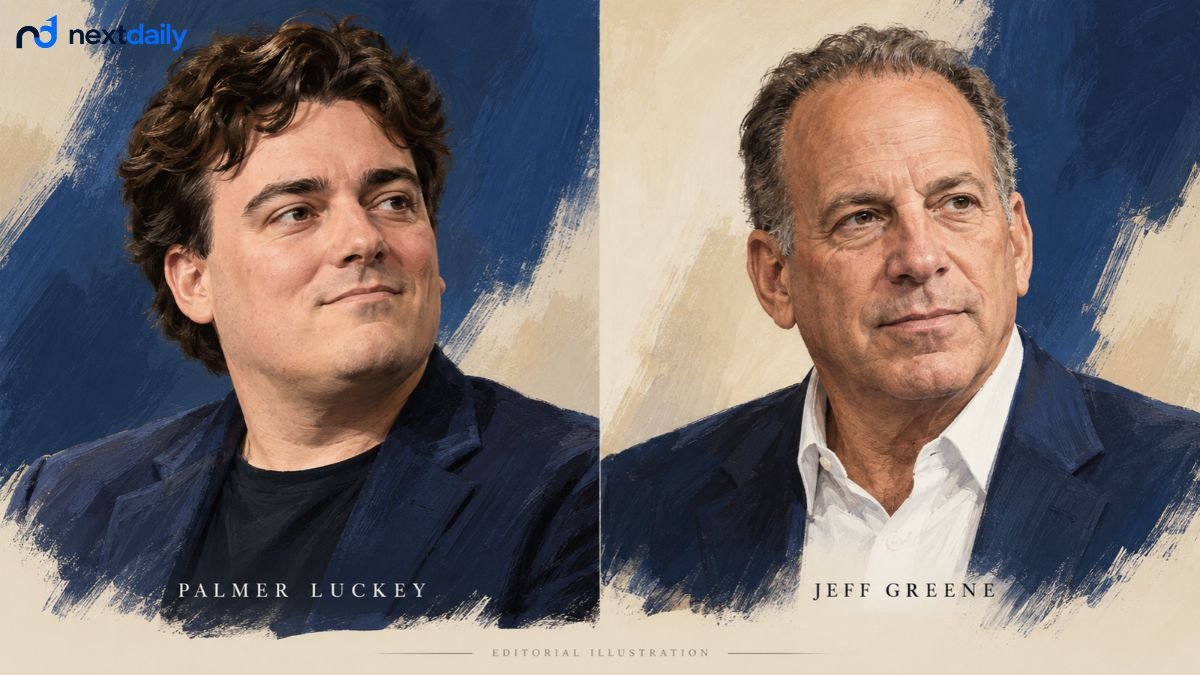
Palmer Luckey and Jeff Greene are entrepreneurs whose careers centre on different businesses. Luckey created the Oculus Rift virtual-reality headset and went on to co-found defence technology company Anduril Industries. Greene built a property portfolio and became widely known for a profitable investment against mortgage-backed debt before the financial crisis. Their business histories offer a comparison between developing technology companies and investing in property and financial markets. They do not establish a shared venture or business partnership.
Understanding their individual achievements means looking beyond large transaction figures. Oculus’s acquisition price described a company purchase, while Greene’s mortgage-market profits came from a particular investment. Neither figure should be mistaken for a current personal fortune.
Palmer Luckey: From a headset prototype to Oculus
Luckey’s early work focused on making virtual reality more convincing and accessible. Virtual reality, usually shortened to VR, uses a headset to place the wearer inside a computer-generated environment that responds to their movements.
In a November 2014 profile, Smithsonian described how Luckey experimented with existing headsets, screens and tracking equipment. He worked on prototypes between 2009 and 2012 while taking college classes and working at the University of Southern California’s Institute for Creative Technologies.
His design combined relatively inexpensive lenses with software that adjusted the image, alongside screens developed for mobile phones. The approach addressed practical problems with earlier equipment, including weight, cost and a restricted field of view.
Game programmer John Carmack helped bring the prototype to wider attention by demonstrating it at the E3 games convention in June 2012. Luckey subsequently developed the business with Brendan Iribe, Michael Antonov and Nate Mitchell. An Oculus Kickstarter campaign raised approximately $2.4 million, providing early funding for the headset project.
What Facebook’s Oculus deal actually involved
On 25 March 2014, Facebook announced an agreement to acquire Oculus for approximately $2 billion. Its official acquisition announcement specified $400 million in cash and 23.1 million Facebook shares, valued at approximately $1.6 billion at the time.
The agreement also included a possible additional $300 million in cash and shares if certain milestones were achieved.
Those details matter when describing Luckey’s financial success: the headline amount was the consideration for acquiring Oculus, rather than a payment identified as going entirely to its founder.
Facebook also reported more than 75,000 orders for Oculus Rift development kits. These were equipment for developers building experiences for the platform. Alongside gaming, the acquisition announcement identified communications, entertainment and education as areas Facebook wanted to explore through VR.
How Anduril expanded Luckey’s career
Founded in 2017, Anduril moved Luckey’s business career into defence technology. Its work encompasses autonomous systems and software that connects information from different sensors and equipment.
The company’s Lattice platform brings those inputs together so that operators can use them within a common system. Anduril describes Lattice as supporting its own equipment while also integrating with technology supplied by other companies and governments. This places software integration alongside hardware development at the centre of its business.
There is also a documented connection between Luckey’s headset background and his later defence work.
In September 2024, Anduril announced a collaboration with Microsoft on the US Army’s Integrated Visual Augmentation System, known as IVAS. The programme uses headsets to present soldiers with information gathered from sensors and other systems.
Anduril said it had integrated Lattice into Microsoft’s IVAS hardware and software, including alerts about detected airborne threats. The company identified Luckey as leading its involvement in the initiative. These were company-reported capabilities, rather than an independent assessment of battlefield performance.
More recently, Anduril’s September 2026 partnership announcement with Voyager Technologies described collaboration on weapons and missile-defence technologies. It stated that Voyager was contracted to supply more than $60 million in technology to Anduril, including rocket motors and control systems.
The announcement illustrates the scope of the company’s work beyond headsets: development, testing and manufacturing for military programmes.
Jeff Greene: Building a property business
Greene’s route into business began with property investment. His educational background includes an undergraduate degree from Johns Hopkins University and an MBA from Harvard Business School.
His first property purchase came while he was an MBA student. In a November 2023 interview with Forbes, Greene explained that difficulty finding suitable accommodation prompted him to consider buying a building.
Following a friend’s suggestion, he purchased a three-family house near Boston. The original plan was to occupy one unit and rent the others. After securing separate accommodation, he rented all three.
Greene told Forbes that he had accumulated 18 properties by the time he finished business school. That account places rental property at the beginning of his investment career, well before the financial trade that later attracted national attention.
The mortgage investment that changed his finances
In 2006, Greene began buying credit default swaps connected to subprime mortgage-backed bonds.
In simple terms, these contracts allowed him to take a position that could pay off if the underlying mortgage debt failed. Subprime mortgages were loans to borrowers with weaker credit, and mortgage-backed bonds packaged mortgage payments into investments.
Forbes’s contemporary reporting described Greene committing $30 million initially and another $20 million over the following year. The position initially moved against him before the deterioration in the mortgage market produced a reported $800 million gain. That was profit attributed to a specific trade, rather than an estimate of his entire wealth.
Property remained central to his finances afterward. Forbes’s profile identifies real estate in Los Angeles and South Florida, alongside equities and other investments, as major components of his fortune. It also records his unsuccessful attempt to win Florida’s Democratic nomination for governor in 2018.
Palmer Luckey and Jeff Greene: The key distinction
The clearest distinction between Palmer Luckey and Jeff Greene lies in what each built and owned.
Luckey’s career centres on technology development: first a VR headset business, followed by a company producing defence software and equipment. Greene’s career centres on property ownership and financial investments, including his position against mortgage debt.
Their publicly documented activities also extend in different directions. For Greene, philanthropy forms part of that record. The Giving Pledge lists Jeff and Mei Sze Greene as having joined in 2011. In the published pledge letter, he committed the bulk of his estate to their foundation and described a desire to expand opportunities for other Americans.
That is a stated philanthropic commitment; it should not be presented as evidence that the entire pledged amount has already been donated. Like the distinction between an acquisition price and personal wealth, it helps keep an account of business success accurate.
Also read
Scooter Braun Net Worth: What His Biggest Deals Really Tell Us
Stephen King and Richard LeFrak: Is There a Connection Between Them?